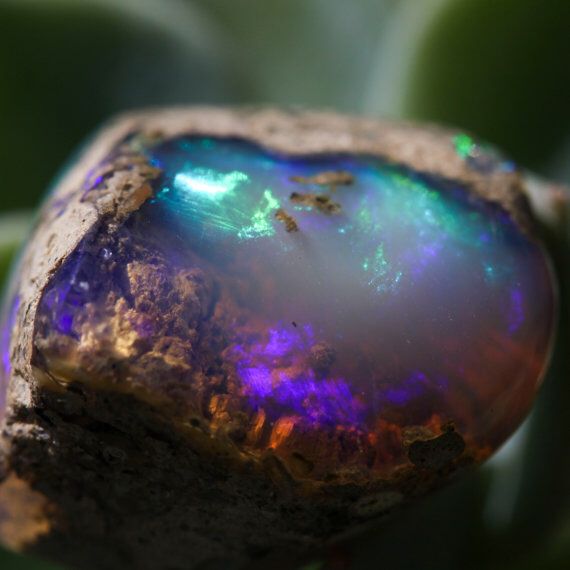
- Play-of-color
- The spectral light show in precious opal. Caused by silica spheres of just the right size scattering light.
- Body tone
- Background darkness, N1 (jet black) to N9 (pure white). Darker bodies make color shout louder.
- Brightness
- How vivid the color is, on a scale B1–B7 (B7 = brightest). Independent of body tone.
- Fire
- In precious opal: another word for play-of-color. In fire opal: the warm orange-red body color itself.
- Flash
- A broad swath of single color that moves with the stone's angle.
- Pinfire
- Tiny, dense pinpoint dots of color across the face.
- Crystal opal
- Highly transparent body, with play-of-color floating in 3D inside the stone.
- Black opal
- Precious opal on a dark body tone (N1–N4). Lightning Ridge is the classic source.
- Boulder opal
- Color forms as veins inside ironstone matrix — the matrix is left as the back of the stone.
- Doublet / triplet
- An assembled stone: thin opal slice on a black backing (doublet), with a crystal cap on top (triplet). Lower cost, more care.
- Hydrophane
- An opal that absorbs water — common in Ethiopian Welo. Soaks up and changes appearance; must be dried before storing.
- Potch
- Common opal — silica without play-of-color. Acts as the dark canvas behind precious opal.
- Cabochon (cab)
- A polished dome cut, the most common opal cut. Maximizes the visible play-of-color face.
- Freeform
- An organic, non-geometric cut that follows the stone's natural shape. Saves material, often more interesting.